AI/ML Engineer building intelligent, production-ready systems.
I am a final-year undergraduate at the Sri Lanka Institute of Information Technology (SLIIT), specializing in Data Science. My passion lies in building AI-powered systems — from RAG pipelines and LLM fine-tuning to computer vision classifiers and NLP applications.
In my previous experience, I built AI-powered document processing systems and RAG pipelines with vector databases for international clients across the UK and US. I complement my ML expertise with strong DevOps skills — Kubernetes, Terraform, GitOps with ArgoCD — ensuring my AI systems are not just intelligent, but reliably deployed and scalable.
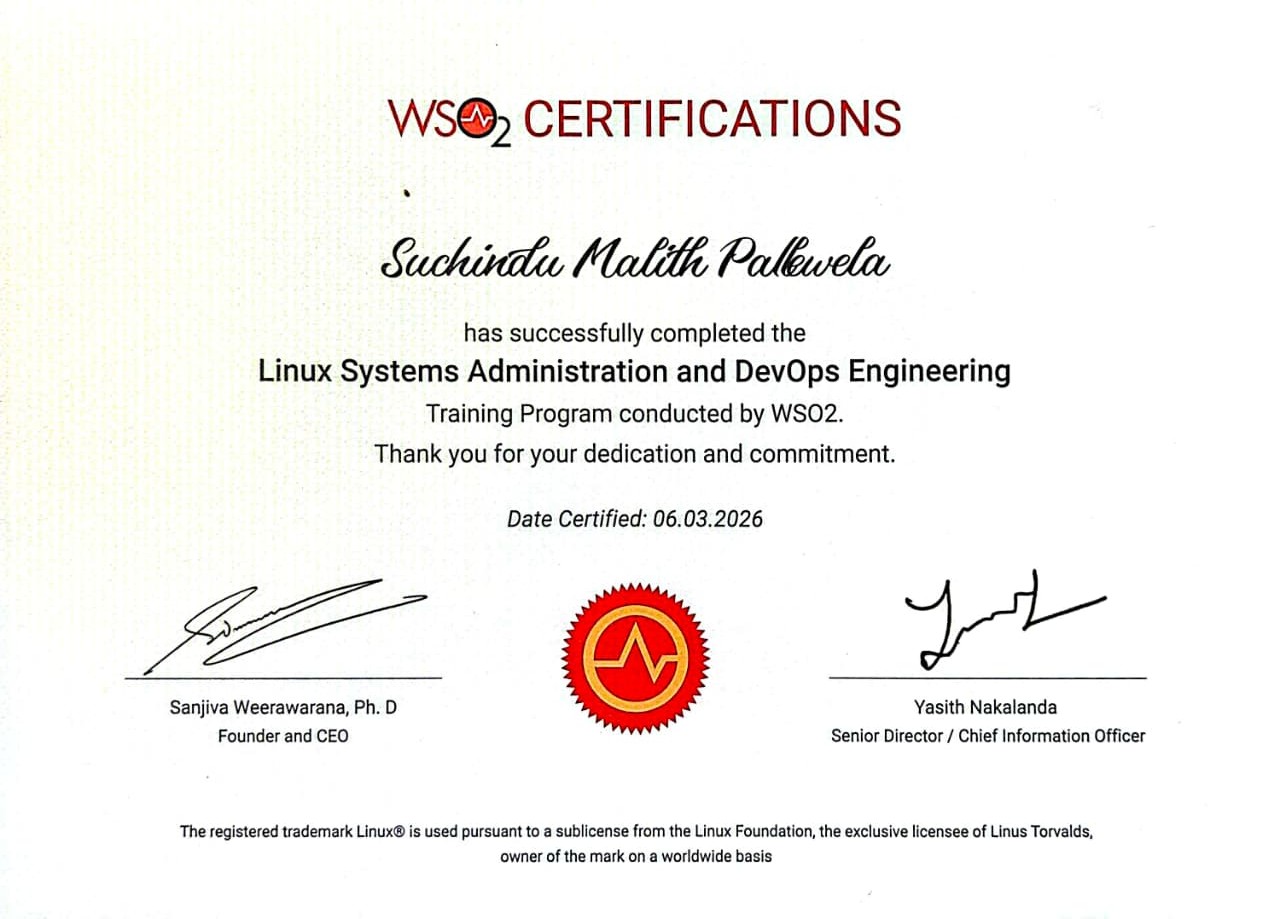
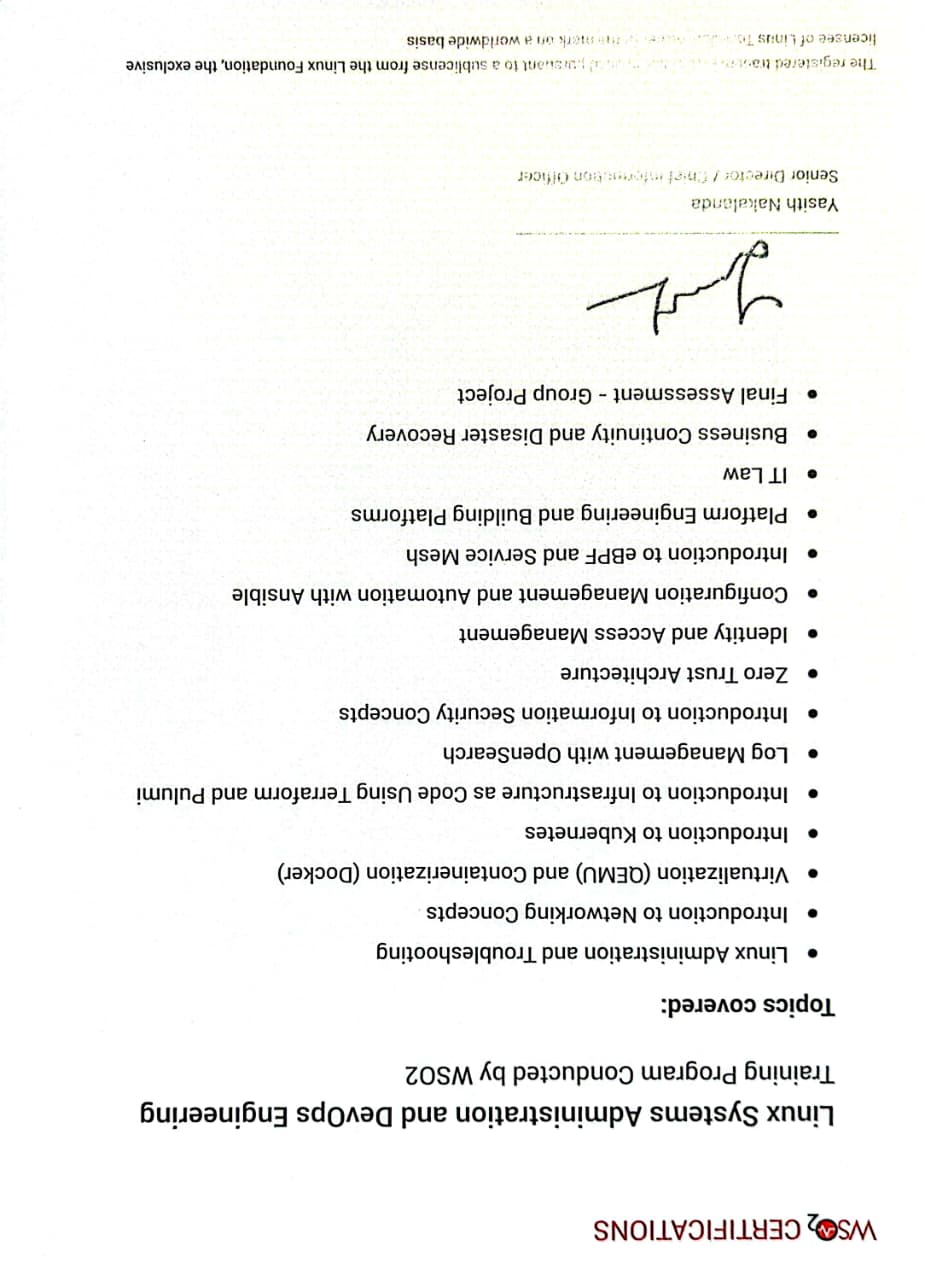
I hold a WSO2-certified DevOps Engineering credential covering infrastructure as code, container orchestration, and Zero Trust security.
My key areas of expertise.
From building RAG systems and fine-tuning LLMs to deploying them on cloud-native infrastructure with full observability — I cover the complete AI-to-production lifecycle.
AI/ML & Deep Learning
End-to-end ML pipelines — from data preprocessing and model training (TensorFlow, PyTorch, Scikit-learn) to LLM fine-tuning with LoRA/QLoRA, RAG systems with Qdrant, and NLP applications with Hugging Face Transformers.
MLOps & Deployment
Containerized ML model serving with Docker, FastAPI, and Flask. Multi-service orchestration with Docker Compose, vector database management, and real-time inference APIs for production environments.
Cloud & Infrastructure
Provisioning cloud-native infrastructure on AWS with Kubernetes (K3s), Terraform IaC, Ansible automation, and GitOps CI/CD with ArgoCD — including Zero Trust security architecture.
Observability & Data
Full-stack monitoring with Prometheus, Grafana, Fluent Bit, and OpenSearch. Data engineering with SSIS, SSAS, Power BI, and Snowflake schema design for business intelligence.
Production experience.
AI/ML & Software Engineering Intern
- Contributed to two concurrent international production systems spanning the UK and US
- UK Invoice Extraction: Centralized end-to-end logging across full document processing lifecycle — ingestion, extraction, validation, transformation, delivery
- Built comprehensive validation pipeline covering financial accuracy, data consistency, and business-rule enforcement
- Developed multi-client, template-based document extraction using coordinate-based parsing
- US RAG System: Owned RAG infrastructure and embedding pipeline; designed Qdrant vector DB configs and semantic embedding workflows with CLIP models
Projects I've built.
Dual-Source RAG Classroom Support System
Aug 2025- Designed a production-ready Dual-Source RAG system integrating real-time audio transcription (Faster Whisper) with static slides in a unified Qdrant vector database, enabling instant Q&A and automated lecture summarization
- Fine-tuned Llama 3.2-3B Instruct via LoRA/QLoRA on an IT-domain dataset (NF4 quantization using Unsloth), achieving a 29.6% training loss reduction and 29.4% perplexity improvement for domain-specific assistant capabilities
- Optimized retrieval using an all-MiniLM-L6-v2 encoder and Qdrant HNSW index, achieving 88% retrieval accuracy (17% gain over baseline) and a production-grade 1.2-second first-token response latency
- Engineered a custom five-layer ASR hallucination defense pipeline (VAD filters, blacklist, verification gates) and two-stage transcript cleaning to ensure content safety and high-fidelity output
- Built a Bloom's taxonomy-aligned MCQ generator with teacher-in-the-loop validation, deployed in a highly scalable, containerized microservices architecture with full service observability
Cloud-Native Library Management System
Mar 2026- Designed and deployed a fully cloud-native, microservices-based Library Management System on a self-managed Kubernetes (K3s) cluster across AWS EC2 instances
- Provisioned cloud infrastructure using Terraform (VPC, Security Groups, EC2, Load Balancer) and automated cluster configuration and software setup using Ansible playbooks
- Built a GitOps-based CI/CD pipeline with GitHub Actions (Build, Unit Test, Trivy Security Scan, Docker Hub push) and ArgoCD with Argo Rollouts for canary and blue-green progressive deployments with automated rollback
- Implemented Zero Trust security end-to-end: Linkerd service mesh with mTLS, Kubernetes RBAC with namespace isolation and default-deny NetworkPolicies, HashiCorp Vault for dynamic secrets management, TLS termination at NGINX Ingress
- Deployed centralized observability stack: Prometheus and Grafana for metrics/dashboards, Fluent Bit and OpenSearch for log aggregation, Alertmanager for pod crash, high error rate, and service downtime alerts
- Microservices stack: ASP.NET Core (C#), PostgreSQL per service, Redis caching, JWT-based RBAC authentication, NGINX Ingress for TLS termination, load balancing, and rate limiting
Alzheimer's MRI Classification
Dec 2024- TensorFlow CNN classifying dementia stages (Non-Demented, Mild, Moderate, Very Mild) from MRI images
- Flask REST API with real-time confidence scoring
- Containerized web service via Docker for production deployment
Text Summarization & NLP
Oct 2024- Hugging Face Transformers for abstractive text summarization
- KeyBERT keyword extraction + sentiment analysis module
- PDF ingestion, user auth, and database management in Flask
LoanDrive — Default Prediction
Sept 2024- SVM + Random Forest with Grid Search hyperparameter optimization
- Precision, recall, F1-score evaluation with rigorous preprocessing
- Real-time Streamlit web application for prediction
Data Warehousing & BI Pipeline
Feb 2025- End-to-end ETL with SSIS, Snowflake schema on SQL Server
- OLAP cube via SSAS for multidimensional analysis
- Interactive Power BI + SSRS dashboards